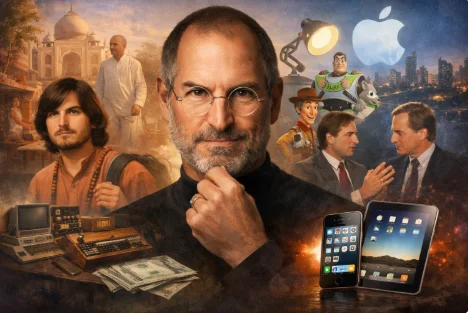
magine a young man in the 1970s boldly declaring: “I will put a personal computer in every home.” At that time, people laughed. He had no technical skills, no management experience, and no money. Yet he possessed something far more powerful — vision. Today, that vision stands as Apple, the world’s most valuable brand.
He was Steve Jobs — an imaginative futurist, radical innovator, and relentless perfectionist. Forbes named him the creator of the world’s most valuable brand. From poverty and setbacks to spiritual searching and unbreakable belief, Steve Jobs transformed the world. Let’s explore his remarkable journey — from childhood struggles to the invention of the iPhone.
Early Life and Struggles
Steve Jobs was born into an ordinary family. His father was a mechanic who loved working with machines in the garage. Young Steve spent hours there, fascinated by tools and technology.
- At age 12, HP co-founder Bill Hewlett gave him a summer internship
- In poverty, he collected empty Coke bottles to buy food
- He walked miles to temples for free meals
His teachers recognized his brilliance early and suggested skipping grades. But Steve never fit the conventional mold. After dropping out of college, he traveled to India in search of his guru, Neem Karoli Baba. By the time he arrived, Baba had passed away. Steve embraced Jainism and Buddhism, became a fruitarian, shaved his head, and wore traditional Indian clothes — dhoti and kurta. These experiences shaped his pursuit of perfection and simplicity.
The Birth of Apple
In 1976, Steve Jobs and Steve Wozniak started Apple in a garage. Wozniak was the technical genius; Jobs was the visionary.
- They sold a Volkswagen and a calculator to raise startup money
- Jobs often met customers in his underwear — he couldn’t afford proper clothes
In 1980, Apple went public. By age 25, Steve Jobs was worth $100 million — one of America’s richest young men.
The First Revolution and Major Setback
The real revolution came in 1984 with the Macintosh — the first truly user-friendly personal computer. But success was short-lived.
In 1985, the Apple board — led by CEO John Sculley (whom Jobs himself had recruited from Pepsi with the famous line: “Do you want to sell sugared water for the rest of your life, or come with me and change the world?”) — forced Jobs out.
Instead of breaking, Jobs bounced back stronger. He founded NeXT (a high-end computer company) and bought Pixar, which later created Toy Story and was sold to Disney, making him a billionaire.
Return and Perfection Obsession
In 1997, Apple was on the verge of bankruptcy. The board begged Jobs to return. He did — and made ruthless decisions:
- Cut 350 products down to 10
- Focused only on what truly mattered
Jobs believed: “Perfection comes from neatness — even the parts no one sees.”
- His father taught him: Build the back of furniture beautifully — even if hidden
- When an employee placed a battery crooked inside a phone, Jobs said: “Fix it. Someone will open it someday.”
He created a dedicated team just to perfect the unboxing experience — removing unnecessary manuals, designing the perfect tape angle, testing thousands of prototypes.
Minimalism became his mantra. Apple’s logo — simple bitten apple — needed no text. One glance, and people knew: it’s Apple.
Marketing Genius and “Think Different”
Jobs redefined marketing:
- “Think Different” campaign positioned Apple as rebellious and creative
- He publicly called Microsoft “tasteless” — “They bring no culture to their products”
He didn’t sell features. He sold dreams.
- “The world’s thinnest notebook.” Period.
- He divided the market: Apple people vs Microsoft people
Jobs created addiction. Once someone bought Apple, they rarely left. The brand became an identity.
iPhone and World-Changing Legacy
In 2007 came the iPhone — not just a phone, but a revolution. In 2010, the iPad. Jobs turned complex technology into beautiful, intuitive experiences.
He once said: “Design is not just what it looks like. Design is how it works.”
Also read this:
Conclusion
Steve Jobs was more than a businessman — he was a dreamer who forced the world to think different. From collecting bottles in poverty to building the most valuable company on Earth, his journey teaches us:
- Vision matters more than resources
- Perfection, even in hidden details, creates greatness
- Focus ruthlessly — say no to 340 things to say yes to the 10 that matter
Steve Jobs didn’t just build products. He built culture, emotion, and aspiration. That’s why today, when you see the Apple logo, you don’t just see technology — you feel possibility.
Key Insights
- At 12, interned with HP co-founder Bill Hewlett
- Traveled India for 7 months seeking spiritual truth
- Worth $100 million by age 25
- Reduced Apple’s 350 products to 10 upon return
- “Think Different” campaign redefined brand identity
FAQs
- How did Steve Jobs start Apple? In a garage with Steve Wozniak — sold personal items to fund the first computers.
- Why was Steve Jobs fired from Apple? In 1985, the board (led by John Sculley) removed him. He returned in 1997.
- What did Jobs do after leaving Apple? Founded NeXT and bought Pixar (sold to Disney, making him a billionaire).
- What was Steve Jobs’ biggest strength? Obsession with user experience and perfection — even in unseen details.
- Why is Apple’s logo so simple? Jobs wanted instant recognition — no text needed. Just the apple.